

What a Vaillant diverter valve does
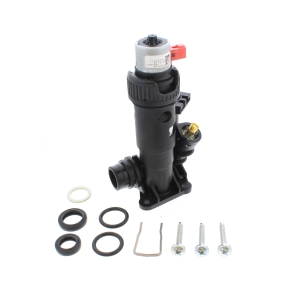
Vaillant’s own glossary describes the diverter valve as “a part inside the boiler that switches the flow of water between hot water at your taps and the central heating”. A combi stores no hot water, so the moment you open a hot tap the boiler has to stop sending heat to the radiators and send it to the tap instead. The diverter valve is the part that makes that switch, and in a busy house it makes it dozens of times a day.
Vaillant also notes on the same page that these valves “can jam or become ‘sticky’, preventing them from working properly”. That is the entire fault in one line. Nothing dramatic happens and the boiler often carries on firing. The valve simply stops moving cleanly between its two positions, so heat starts going to the wrong place, and you pay for all of it either way.
Because the switching happens inside the casing you cannot see the valve, test it or free it off from outside. Nor are you allowed to try. Vaillant puts it plainly in its own leak advice: “Do not remove the boiler casing yourself, as it is illegal for a non-qualified individual to do so.” HSE states that “under the Gas Safety (Installation and Use) Regulations 1998 for a gas engineering business to legally undertake gas work that is within the scope of the Regulations they must be on the Gas Safe Register”.
Signs of a faulty Vaillant diverter valve
Vaillant lists three symptoms on its own diverter valve advice page, worded the way a customer would say them: “I have hot showers but my radiators stay cold”, “I can only get lukewarm water from my taps”, and “My hot water only turns on when central heating is on”. Here is what each one tends to feel like day to day, plus a fourth sign that sends people looking for a diverter valve fault for a different reason.
1. Only lukewarm water from the taps
This is the one most people notice first. The shower is warm rather than hot, and turning the tap further towards hot changes very little. If the valve is not closing fully on the heating side, part of the boiler’s output keeps heading off to the radiators while you are stood in the shower, so the water reaching you was never given full heat in the first place. Rule out the simple things first: a hot water temperature dial knocked down, or a fault code showing on the display.
2. Hot showers, but the radiators stay cold
The mirror image, and the one that gets blamed on the pump or the thermostat. A combi always prioritises hot water, so radiators cooling for a few minutes while someone runs a bath is normal behaviour, not a fault. What is not normal is radiators that stay stone cold after the taps are off and the heating has been calling for a while, when the boiler itself is clearly firing and getting hot.
3. Hot water only when the central heating is on
Vaillant names this one specifically. It shows up most in summer, when the heating has been off for weeks and the taps run cold or barely warm. Switch the heating on for a few minutes and the hot water suddenly appears. That pattern points at a valve that is no longer moving to the hot water position on its own, and it is a useful thing to be able to describe when you book.
4. Damp patches, or a pressure gauge that keeps falling
A valve can also fail wet rather than stuck. That behaves differently from the three signs above, so it has a section of its own next.
A leaking valve and a dropping pressure gauge
Diverter valve bodies carry seals, and Vaillant is direct about what happens to seals over time: “These seals can loosen or break over time and cause water to leak from the system. This natural wear and tear occurs as a result of water expanding and contracting…” A leak at the valve is therefore an age and wear problem rather than something you caused.
The valve sits inside the sealed heating circuit, so water escaping past a worn seal takes pressure out of the system. Vaillant gives the normal running range as 1 to 1.5 bar, and when the pressure falls far enough the boiler locks out and shows F.22, which Vaillant lists as “Low water pressure in the system”. The awkward part is that the water can be escaping inside the casing, so you may top the system up, watch it fall again over days or weeks, and never find a damp patch anywhere in the house. A gauge that keeps dropping with no visible leak is worth saying out loud when you book the visit.
If you can see water around or under the boiler, Vaillant’s advice is to “turn off the water supply and your heating, wipe off any water from the area and contact a Gas Safe Registered (GSR) engineer”. Do not keep repressurising a system that will not hold its pressure, and do not take the casing off to look. Water and live electrical components sharing one box is the reason this one is a soon job rather than a wait-and-see job.
If you smell gas at any point, this stops being a plumbing problem. Leave the property and call the National Gas Emergency Service on 0800 111 999, free, at any hour.
Vaillant fault codes a stuck valve can put on the display
Vaillant publishes no fault code for the diverter valve itself, which is why the three signs above carry so much weight: on a Vaillant this fault normally arrives with a blank display and nothing to look up. What a stuck valve does instead is turn up second hand, on the codes Vaillant raises for poor circulation and for the pressure a weeping valve costs you.
- F.84 — the flow and return sensor readings disagree. A seized pump, a stuck diverter or zone valve, sludge, scale or an airlock can each restrict flow enough to raise it, so the diverter valve is on the circulation checks an engineer works through on an F.84 visit.
- F.25 — a safety lockout on flue gas temperature. Vaillant sends this one straight to an installer, and the diverter valve sits on the list they check alongside the flue gas safety temperature limiter, the harness and board connections, the pump and the internal air vent.
- F.22 — low water pressure in the system. This is the wet failure described above rather than a stuck one: a valve seal that keeps bleeding the system down eventually takes the boiler below its 1 to 1.5 bar range and locks it out.
Read it in that direction. A code on the display never rules the diverter valve out, and a blank display with heat arriving in the wrong place points hard at it. Vaillant’s full list is on Vaillant’s fault code page.
Clean or replace: how the fault gets fixed
The first job is not the valve at all, it is proving it is the valve. Several other faults produce the same lukewarm taps and cold radiators, from a hot water temperature setting that has been turned down, to a pump problem, to service valves on the pipework left part-closed after work in the house. An engineer runs checks before anything is stripped down, which is exactly why guessing the part yourself and ordering it online tends to cost more, not less.
Where the valve is the cause, it does not automatically mean a new part. Vaillant’s own guidance is that “it is likely that the valve has simply become stuck over time and needs to be cleaned using a commercial chemical cleaner, after which it can be refitted”, and that “the engineer may also advise you to replace the valve depending on the severity”. A cleaned valve is the cheaper outcome, and it is a real one on boilers that have simply furred up.
Replacement is the answer where the valve is leaking, where the motor no longer drives it, or where it opens and closes at the wrong times and will not respond. Seals that have perished cannot be cleaned back to life the way limescale can be dissolved off, so a wet valve is nearly always a change rather than a clean.
If you have no hot water at all rather than lukewarm water, work through our safe checks for no hot water before you book, because a timer or a pressure problem is a far more common cause than a diverter valve. If your boiler is not a Vaillant, or you want the picture across every make, our guide to a faulty diverter valve on any combi boiler covers how the same fault is told apart from a thermistor or circuit board problem and how the repair differs brand to brand.
Vaillant diverter valve replacement cost
There is no single price for this job, because the part depends on your model and the labour depends on what the engineer finds when the casing is off. The bill is made of two separate things, and only one of them is the part.
Vaillant sets out both on its own advice page: “the cost of the engineer’s time and the replacement valve itself, which can cost anywhere between £55 and £200”. That range is the manufacturer’s own figure for the part, not ours.
What moves your bill inside that range:
- Clean or replace. A stuck valve that cleans up and goes back in costs labour and a chemical cleaner. A replacement adds the part on top.
- The exact model and serial number. The right part is identified from the model and serial number printed on your boiler and installation paperwork, not from the name on the front. Vaillant has sold combis under several ranges, including the ecoTEC plus, the ecoTEC pro, the ecoTEC exclusive and the ecoFIT pure, and the range name on the door will not tell an engineer which assembly yours takes. Have both to hand when you book, so the engineer can check what your boiler takes before travelling.
- Whole assembly or seal kit. Some faults are answered by a smaller kit, others need the complete valve. That is the engineer’s call once it is out.
- Genuine parts. Vaillant’s guarantee terms state that “the use of any non-genuine Vaillant spare parts in any repair will invalidate the guarantee”, so on a boiler still inside its guarantee period a cheaper pattern part is a false economy.
- One visit or two. If the part is not on the van, expect a second visit, and ask at the time whether that visit is charged.
- Who pays. A live Vaillant guarantee, or a boiler cover plan, changes the number you actually see. Both are covered below.
If the boiler is elderly and this is not its first repair, the honest question is whether to keep spending. Our guide on repairing versus replacing a boiler works through that decision.
Need a Gas Safe engineer.
A diverter valve is inside-the-casing work, so it needs a Gas Safe registered engineer. We work with a national network of thousands of Gas Safe registered engineers. On a Smart Plan cover plan we aim to get an engineer out to you within two working days, with call-outs booked Monday to Friday, 08:00 to 18:00. A failed diverter valve counts as a boiler and central heating repair, covered where that module is on your plan and the plan’s exclusions do not apply. Parts and labour are paid up to your cover limit, which is £500 while the boiler is under seven years old and £200 once it is over seven. A £95 call-out fee, paid in advance, applies in the first 30 days of a new plan, for issues your plan does not cover, where we cannot get access, and for an annual service requested early. Cover still applies in those first 30 days, and the cover plan terms list the fee cases in full.
Is it covered by your Vaillant guarantee?
A diverter valve is a component inside the boiler, so on a boiler still inside its guarantee period it is the sort of failure the manufacturer’s cover is meant to handle. Vaillant states that the guarantee covers material and labour charges to repair or replace components within the boiler against manufacturing defects, where the work is carried out by Vaillant or an approved Gas Safe registered engineer.
Three conditions catch people out:
- Registration. Vaillant’s guarantee terms say “the boiler guarantee must be registered within 30 days of installing the appliance. Failure to register within this time period will result in the guarantee reverting to 12 months from date of installation.”
- Annual servicing. Vaillant requires that “the boiler must be serviced annually by a Vaillant or other registered Gas Safe Registered engineer”.
- Dirty system water. This is the one that bites on diverter valves. Vaillant’s terms state that “if any failure is caused by contaminated water in the boiler (e.g. blockages, or influences of flux residues, iron oxides, limescale, sludge etc.) the engineer’s visit becomes chargeable”. Limescale and sludge are exactly what jams a diverter valve, so a valve fault can fall inside the guarantee period and still be billed to you.
Guarantee lengths differ by product and by who fitted the boiler. Vaillant states that the ecoTEC plus “includes a 5-year standard guarantee, which can be extended up to 10-years when fitted by a myREWARDS installer”. Vaillant’s own footnote on that page adds that “Eligibility applies when registered with either the Boiler Protection Kit or the Advanced Boiler Protection Kit (filter)”, so the extension is not automatic. Before you pay for anything, find out where you stand: our walkthrough on checking a Vaillant boiler guarantee shows you what to look for. Have your serial number to hand before you call Vaillant. If the boiler is showing a code, the full list is on Vaillant’s fault code page.
On an older boiler, weigh the repair against the machine. Vaillant’s own view is that “in some cases it may be more economical long-term to replace the entire boiler system, which can be the case for combi boilers over 10 years old”. A boiler that has already needed a fan or a pump is telling you something.