

Smell gas?
If you smell gas, follow these steps immediately
- Call the National Gas Emergency Service on 0800 111 999
- Open all the doors and windows
- Shut off the gas supply at the meter control valve, if you know where it is
- Do NOT use electric switches or naked flames
- Contact a Gas Safe registered engineer to check the appliance
Do you have a heat only Ideal boiler?
Look for a pressure gauge before you decide this page is not for you. A regular or heat only boiler on an open-vented system is fed by a small feed-and-expansion tank in the loft, which tops its own water level up. That kind of system has no gauge and no filling loop, and it cannot be repressurised, so nothing on this page applies to it.
Plenty of Ideal heat only boilers are fitted to a sealed system instead, with an expansion vessel, a filling loop and a pressure gauge. Ideal’s own Logic Heat user guide tells those owners to “Check system water pressure is between 1 & 1.5bar on the system pressure gauge” and to re-pressurise the system if it is low. So the gauge is the test: if you have one, everything on this page applies to you exactly as it does to an Ideal combi or system boiler. No gauge means open-vented.
What should my Ideal boiler pressure be?
Between 1.0 and 1.5 bar when the heating is off and the system is cold. Ideal Heating states it in its own guidance: “The normal cold operating pressure is between 1.0 and 1.5 bar” (Ideal Heating, topping up boiler pressure).
The reading moves while the boiler runs, which is why one number is never the whole answer.
| When you look | What the gauge should show |
|---|---|
| Heating off, system cold | 1.0 to 1.5 bar |
| Heating on, water hot | A little higher. The reading rises by a few tenths of a bar as the water heats, which is normal |
| Anything over 2.75 bar | Too high. Ideal: “If it’s over 2.75 bar, then it’s likely you’ve got high boiler pressure” (Ideal Heating on high boiler pressure) |
Water expands as it heats, so a rise of a few tenths of a bar once the heating fires is normal and is not a fault. What matters is the cold reading, because that is the one you set and the one that tells you whether water is leaving the system.
Those are Ideal’s published figures. Worcester Bosch, Vaillant and Baxi each word it slightly differently, and there is a separate reading for a system that is running rather than cold, so if you want the numbers side by side see the bar readings a healthy boiler should show.
Where is the pressure gauge on an Ideal boiler?
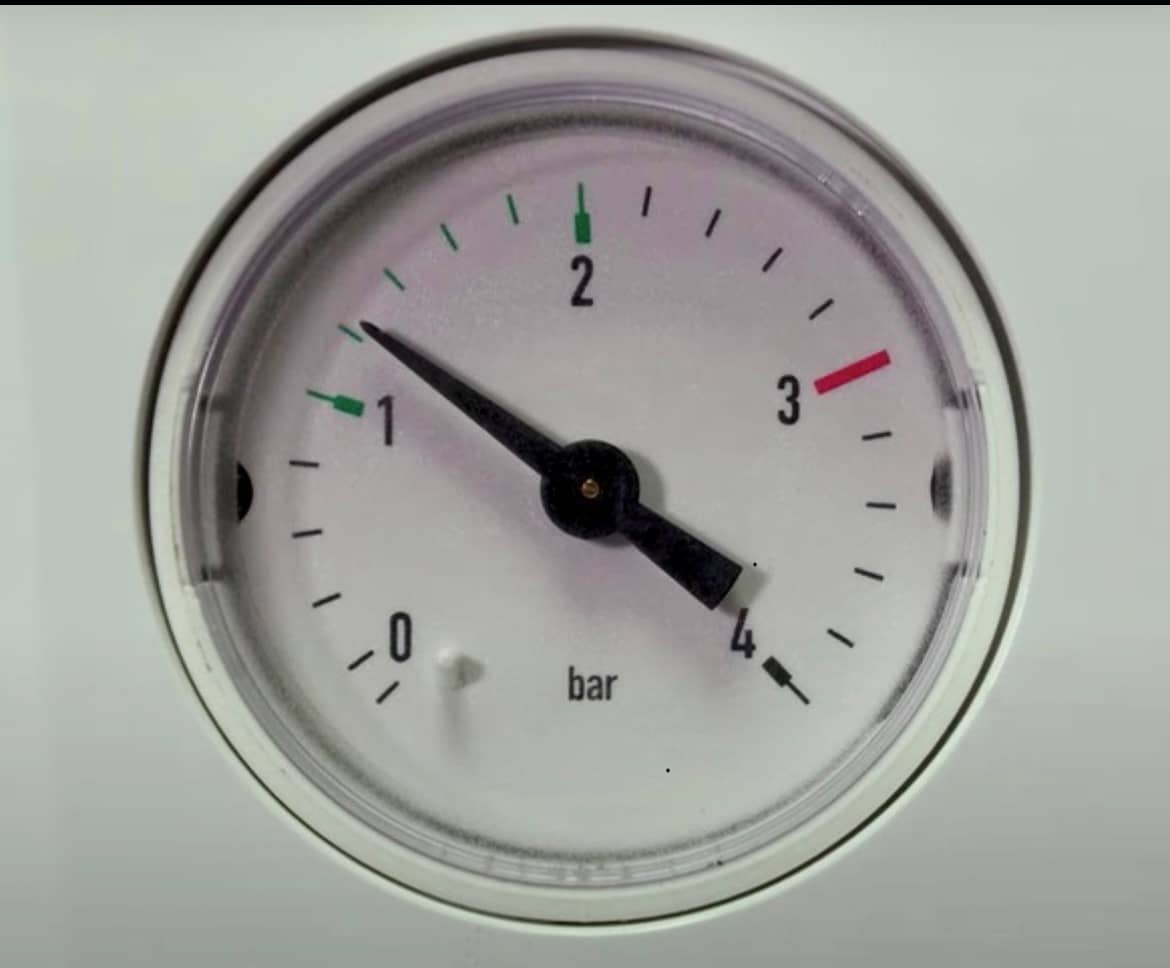
It depends on how old the boiler is, and Ideal splits it at 2016.
- Boilers made in 2016 or earlier. Ideal: “Boilers manufactured in 2016 or earlier may have a separate pressure gauge fitted to the pipework beneath the boiler, close to the isolation valves.” On a lot of Ideal Logic installations this is a small round dial hanging below the casing, next to the coloured valve handles, and people miss it because they are looking at the front panel.
- Boilers made from 2016 onwards. Ideal: “On boilers manufactured from 2016 onwards, the pressure gauge or pressure display is generally located on the front of the boiler.” It can sit behind a drop-down cosmetic flap, so pull the flap down before you decide you do not have one.
The dial itself is marked. There is a green band, and the needle wants to sit inside it with the heating cold. If the needle is on or near zero, that is not a broken gauge on its own, it is usually genuinely low pressure.
How to tell your Ideal pressure is too low
- The needle is below 1 bar with the heating off
- Your radiators are not warming up properly
- There is no heating and no hot water at all
- The display is showing F1
F1 is the Ideal code for low water pressure. Ideal’s Logic troubleshooting guide labels it “Low Water Pressure” and says “check to see if the system water pressure is between 1 & 1.5bar”. Our full guide to the Ideal F1 fault code goes through it step by step.
Two corrections worth having, because they get misreported. L1 is not a pressure code on an Ideal: it is a flow temperature overheat, or no water flow through the boiler. L9 is not a pressure code either: it means an unconfigured printed circuit board. If you are staring at a letter and a number, check it against the full Ideal fault code list before you start topping anything up.
Ideal’s published Logic code list has a code for low water pressure and none for high pressure. High pressure shows itself on the gauge and at the discharge pipe outside, not on the display.
Why is my Ideal boiler pressure low?
A sealed heating system does not use water up, so if the gauge has dropped, water has left it. Two harmless explanations cover most one-off drops: you bled the radiators recently, which lets a little water out with the air, or the boiler has sat idle all summer. Top it back up once and the gauge should hold.
The Ideal-specific part is the benchmark to judge it against. Ideal’s Logic troubleshooting guide treats the cold reading the installer set as the yardstick, calling it “the original installation pressure of 1-2 bar”, so a cold gauge that keeps sinking below where it started is the sign to act on. Ideal’s own first check is to “Check around the radiators where the pipework enters and leaves”, and its second is to “Check the outlet pipe...for any drips”, meaning the copper discharge pipe on the outside wall behind the boiler. Ideal also makes a point most guides skip: topping up repeatedly with plain water weakens the corrosion inhibitor, which quietly makes the next fault worse.
Past that, the causes are not Ideal-specific and we have not repeated them here. A hidden leak, a passing pressure relief valve and a failed expansion vessel each behave differently on the gauge, and the full diagnosis, including what an engineer checks and in what order, is in our guide to pressure that will not stay up.
How to increase your Ideal boiler pressure
Topping up an Ideal combi or system boiler takes about five minutes with the filling loop. The filling loop is the link that lets mains water into the sealed heating circuit. Ideal describes it as “A flexible silver filling-loop hose underneath the boiler, connecting two pipes in the shape of a horseshoe”, or on some installations “A ridged connection pipe underneath the boiler” doing the same job.
Note that second description. On plenty of Ideal installations the loop is that fixed ridged pipe, already in place with its own pair of handles, rather than a hose you have to attach. Look underneath the boiler first, before you go hunting for a part you may not be missing.
The steps below are Ideal’s own, for an Ideal boiler. If what you are looking at is a blue keyless lever, a keyed port or an external braided hose near a hot water cylinder, those are other makers’ designs and each one is covered in how to top a gauge below 1 bar back up.
The rule for the handles: a handle in line with the pipe is open, a handle across the pipe is shut. That one fact explains most filling-loop confusion.
Ideal’s own seven steps are:
- Switch the boiler off and let it cool.
- Check the pressure gauge so you know your starting point.
- Locate the filling controls underneath the boiler. If a loop hose has to be fitted, remove the cap, connect both ends and make them hand tight.
- Open the filling controls slowly. Turn one handle a little way so it starts to line up with the pipe. You should hear water moving.
- Stop between 1.0 and 1.5 bar. Close both handles fully, back across the pipe.
- Bleed the radiators if air has got in, then re-check the gauge, because bleeding drops it again.
- Switch the boiler back on.
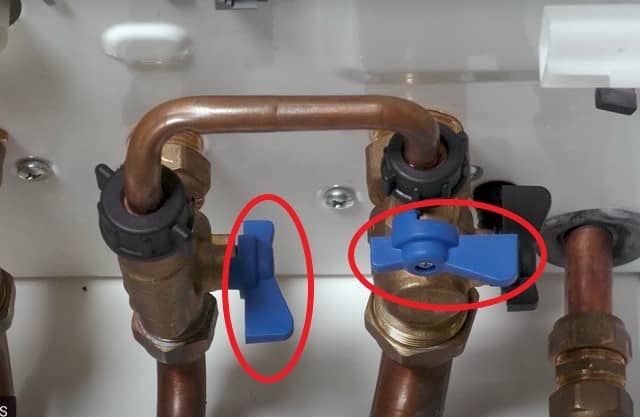
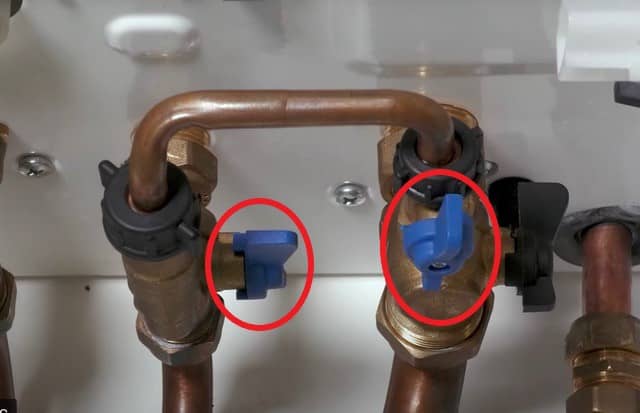
Once the gauge is right, shut both handles, and if you fitted a separate loop, disconnect it and refit the cap. Keep a towel handy, because the loop holds a little water. An F1 normally clears by itself as soon as the pressure is back above 1 bar, without a reset.
When to stop and call someone
Ideal says to contact your installer or a Gas Safe engineer if “Water is leaking from radiators, valves, joints or heating pipework”. Do not keep refilling a system that is visibly leaking, and do not use a top-up to paper over a failed expansion vessel.
Ideal boiler pressure not going up?
You have opened the filling loop and the needle has not moved. Work through these in order.
- Are the handles actually open? They turn 90 degrees. In line with the pipe is open, across it is shut. Half a turn is not enough.
- Is the loop connected at both ends? On a detachable loop, one end is often left hanging with a cap on it. Both ends need to be on and hand tight.
- Is the mains water on? If the cold mains has been isolated, or a stopcock near the boiler is shut, there is nothing to let in. Run a cold tap to confirm you have mains pressure.
- Can you hear water? If you can hear it flowing and the needle still does not move, the gauge itself may have failed, or you may be filling a system that is losing water as fast as you put it in.
- Does it rise and then fall straight back? That is a leak or a passing pressure relief valve, not a filling problem.
If none of that moves the needle, stop there. Working a filling valve that is doing nothing is how a small job turns into a bigger one, and the next step is a diagnosis rather than another attempt.
How to tell your Ideal pressure is too high
- The needle is over 2.75 bar, which Ideal treats as high pressure (Ideal Heating on high boiler pressure)
- Water is running or dripping from the small copper discharge pipe on the outside wall behind the boiler
- The system is noisy: rattling, humming or banging
- Pressure climbs on its own over hours or days without anyone touching it
There is no Ideal fault code for high pressure, so nothing on the display will warn you. The gauge and that outside pipe are the only signs you get.
Why is my Ideal boiler pressure high?
Ideal lists three causes: a filling loop left open, a system filled too far in the first place, and a faulty expansion vessel. On an Ideal the first is much the most common, because the loop is often that fixed ridged pipe with a handle at each end, and it is easy to close one and leave the other at an angle. Mains water then trickles in and the pressure climbs day after day. Check the photo above for what fully shut looks like. Set the gauge cold, between 1.0 and 1.5 bar, and let it rise from there, and note that Ideal is clear a suspected faulty expansion vessel needs a Gas Safe registered engineer to inspect it.
The wider set of reasons a sealed system over-pressurises, and how to tell a simple overfill from a fault, is in our guide to bringing high boiler pressure back down.
How to decrease your Ideal boiler pressure
Do the Ideal-specific bit first: shut both filling-loop handles properly, sitting across the pipe rather than in line with it. On an Ideal that is usually the whole cause, and there is no point letting water out of a system that is still being fed.
Getting the excess out is then the same job on every make, so we have not repeated the method here. Bleeding a radiator with the heating off and the system cold is the simple route, and the drain point under the magnetic system filter is the alternative when bleeding will not do it. Both are set out step by step, with the gauge readings to stop at, in our guide to bringing high boiler pressure back down. Close whichever you use at 1.0 to 1.5 bar cold.
Never remove the boiler casing. Anyone employed to work on a gas appliance must be Gas Safe registered under the Gas Safety (Installation and Use) Regulations 1998, and opening the case is not a homeowner job.
Ideal Logic 2 recall: fire risk from dry operation
The government has published a product recall covering a range of Ideal boilers (gov.uk recall 2401-0138). The notice describes the fault as dry operation, where “the boiler lights gas but the heat generated does not cool it”, and states that “The product presents a risk of fire due to the dry operation”. It applies to “all production of these models with a production date of prior to the 8th of January 2024”.
Ideal’s own safety notice names the affected ranges as “Logic Combi2, Logic System2, Logic + Combi2, Logic + System2, Logic MAX Combi2, Logic MAX System2, iMini2, Independent Combi2, Keston Combi2, Keston System2” (Ideal Heating customer safety notice). Ideal tells owners they can check whether their boiler is affected “using the dedicated webpage www.idealsupport.co.uk or by calling the freephone number 0808 175 9173”, and the gov.uk notice says an affected boiler “should be repressurised to 1.5 bar”.
So if your boiler is one of those models and it is sitting low, do not leave it low. Read the model name off the front, check it against Ideal’s list, and register for the safety upgrade.
What does an Ideal pressure problem cost to put right?
The honest answer is that the gauge reading tells you nothing about the bill, so we will not invent a figure. Three things drive it.
- What has actually failed. Topping up costs nothing at all. A pressure relief valve or a gauge is a small part on an accessible pipe. An expansion vessel is a bigger job. A leak buried under a floor or in screed is the expensive one, because the cost sits in finding it and getting at it rather than in the fitting itself.
- Whether the boiler is in warranty, and what that warranty actually covers. Ideal’s warranty FAQs are specific: “the manufacturer’s warranty only covers manufacturing issues with the appliance. If there are any problems with your system, such as radiators or pipework, you should contact the installer who fitted the boiler system.” A leaking pipe under your hall floor is therefore not a boiler warranty job, even on a new boiler. Ideal also requires that “the boiler must be registered within 30 days of installation”, and where that is missed, “the period of guarantee will be reduced to 12 months from the date of installation”. Our Ideal boiler warranty guide covers how to check yours.
- Whether you pay per visit or spread it. A one-off repair is one bill on one day. A cover plan turns it into a monthly amount, with a limit on what the plan covers in a 12-month period.
Get the fault diagnosed before you agree to anything. A price quoted over the phone from a gauge reading is a guess.
If you would rather not meet a repair bill cold, a Smart Plan boiler and central heating cover plan puts parts and labour on a plan instead, up to £500 in a 12-month period if your boiler is under seven years old, or £200 if it is older. It is a service plan, not insurance, and you build it from the modules you want. Once you use a repair, a 12-month agreement period applies. Read the leak terms before you rely on it: repairs to leaks found as the result of a breakdown or call-out are carried out using “compression fittings, push fit fittings, couplings and or other methodologies for short term leak prevention”.
When to call a Gas Safe registered engineer
Some of this is judgement and some of it is the law. The HSE is blunt about the legal part: “Anyone employed to work on gas appliances in domestic premises must be a Gas Safe registered engineer and competent in that area of gas work” (HSE guidance for homeowners). Reading a gauge and using a filling loop is fine. Opening the boiler is not.
Book an engineer when:
- The pressure drops again within days of topping it up
- You are topping up more than once or twice a year
- The gauge falls to zero
- You can see water at a radiator, a valve, a joint or on pipework
- Water runs from the discharge pipe outside
- Pressure swings a long way between hot and cold, which points at the expansion vessel
- The filling loop does nothing at all
You can check any engineer’s registration on the Gas Safe Register before they start work.
Ideal boiler pressure: quick answers
Can I top up an Ideal boiler while the heating is on?
Better not to. Ideal’s first step is to switch the boiler off and let it cool. Hot water has already expanded, so the reading you fill to is not the reading you get once it cools.
Is 2 bar too high on an Ideal boiler?
Cold, yes, that is over-filled and worth letting down to between 1.0 and 1.5 bar. Hot, 2 bar on its own is not an emergency. Ideal’s threshold for calling it high pressure is over 2.75 bar.
My Ideal shows F1 but the gauge looks normal, what now?
Read the gauge cold rather than hot, because a hot system can mask a low cold reading. If it genuinely sits between 1 and 1.5 bar cold and F1 is still showing, the pressure sensor or the gauge is the suspect rather than the water, and that is an engineer’s call.
Where is the filling loop on an Ideal Logic?
Underneath the boiler, on the pipework. Ideal describes it as either a flexible silver hose linking two pipes in a horseshoe shape, or a ridged connection pipe doing the same job. It is not inside the casing, and you should never open the casing to look for it.
My Ideal will not restart after I topped it up, what now?
Reset it once, using the method in your user guide. If the code comes straight back, treat it as a genuine fault and book an engineer rather than resetting again.
Not an Ideal, or a different symptom?
Four of the five pressure questions people ask are not make-specific, so they live on their own pages rather than here.
- The gauge is sitting below 1 bar: how to top the pressure back up, loop by loop
- The gauge is above the green band: how to let the pressure back down
- You top it up and it drops again: tracing where the water is going
- You only want to know what the reading should be: the normal bar figures, cold and running
- Your Ideal is showing F1 right now: the Ideal F1 low water pressure code, step by step